
Impossible Fibers

Glass Noodle: spinning milk proteins into hollow-core optical fibers

We're growing hollow glass fibers from casein, the protein that makes milk white. Casein is an inexpensive by-product of dairy, so it could make these fibers from an abundant starting material. The project is funded by ARIA's Universal Fabricators programme.

Read The project and full team on ARIA ↗

Why hollow-core fibers

Hollow-core optical fibers guide light through air instead of solid glass, so signals travel faster and lose less. Today they are drawn from glass at around 2,000 °C, which takes a lot of energy and is hard to scale.

How we're making them

Five steps take a common protein to a hollow glass fiber. The fiber's shape and the glass grown on it are set in separate steps, so each can be tuned on its own. The project is developing each step.
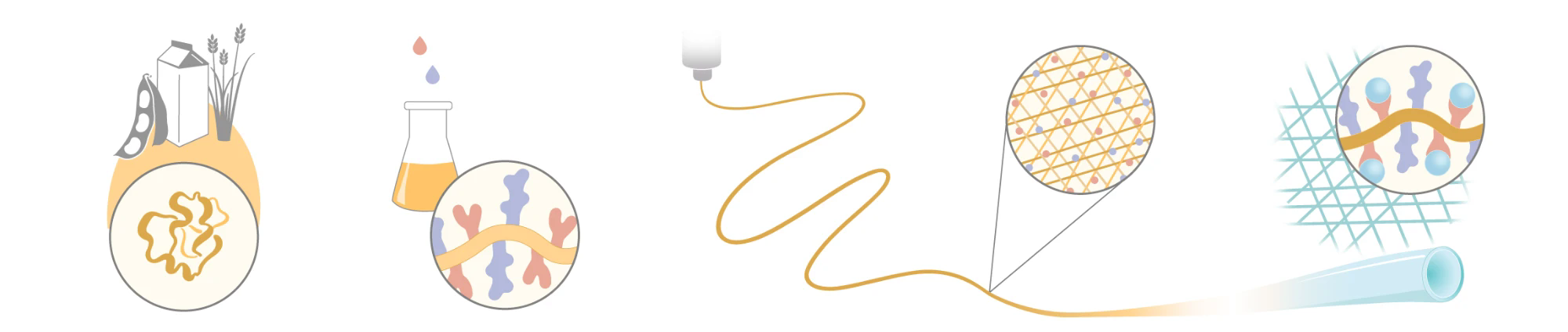
Illustration of five steps: proteins from milk, soy and grain; a flask where the protein is chemically modified; a fiber being spun from a nozzle; a close-up of the fiber's crosslinked nanostructure; and silica growing on the fiber to form a hollow glass tube
  1. Protein selectionStart from abundant, low-cost proteins, including by-products such as casein from dairy, chosen for their structure and chemistry.
  2. Chemical modificationUse established chemistry to change the protein so it behaves like the silica-forming proteins found in nature.
  3. Fiber spinningSpin the protein into fibers, with established or new methods, to set their size and shape, including a hollow core.
  4. Self-assembly and crosslinkingThe proteins organize into a nanostructure inside the fiber, and crosslinking sets how durable it is.
  5. SilicificationSilica grows on the protein template, following the fiber's shape. The protein can then be removed, leaving a hollow glass fiber.
Illustration © Gretchen Hooker / Pixel Naturalist

Team

  1. Impossible FibersLeads the project; microfluidics.
  2. Grouse FibresWet spinning.
  3. University of NottinghamProtein conjugation, with the Mitchell Group.
  4. University of ExeterIn-situ measurement, with the Chen Group.

Goals

Questions about the project?

info@impossiblefibers.com